
US Navy and ExxonMobil
Ongoing
Propwash module available commercially as part of EEMS11; ongoing development for project needs.
Modeling water and sediment transport patterns due to propeller wash (propwash) in near shore areas is critical to planning successful cleanup of contaminated sediment sites as well as preventing resuspension, and designing structures to avoid development of scour holes. Until recently, limited availability of field data, computing capabilities, and other resources have hampered efforts to simulate propwash-related sediment resuspension. The available propwash models have been empirical models that only address velocity and shear at the sediment interface; these are decoupled from far field transport and ignore propeller velocities in the water column.
DSI has developed a fully integrated propwash module in our flagship three-dimensional (3-D) hydrodynamic modeling software, Environmental Fluid Dynamics Code Plus (EFDC+). The propwash module can simulate water velocity, shear stress, and sediment resuspension using ship information, position, and speed, in a 3-D model of the waterbody. Optionally, the propeller energy can be incorporated into the three-dimensional flow field behind the ships. Vessel traffic or AIS data can be automatically imported to provide ship traffic and vessel characteristics needed. The EEMS propwash module is a game changer for contaminated sediment remediation teams in their efforts to properly consider the role of propwash in their evaluations and designs, and for port and harbor engineers evaluating foundation and bulkhead impacts due to propeller action.
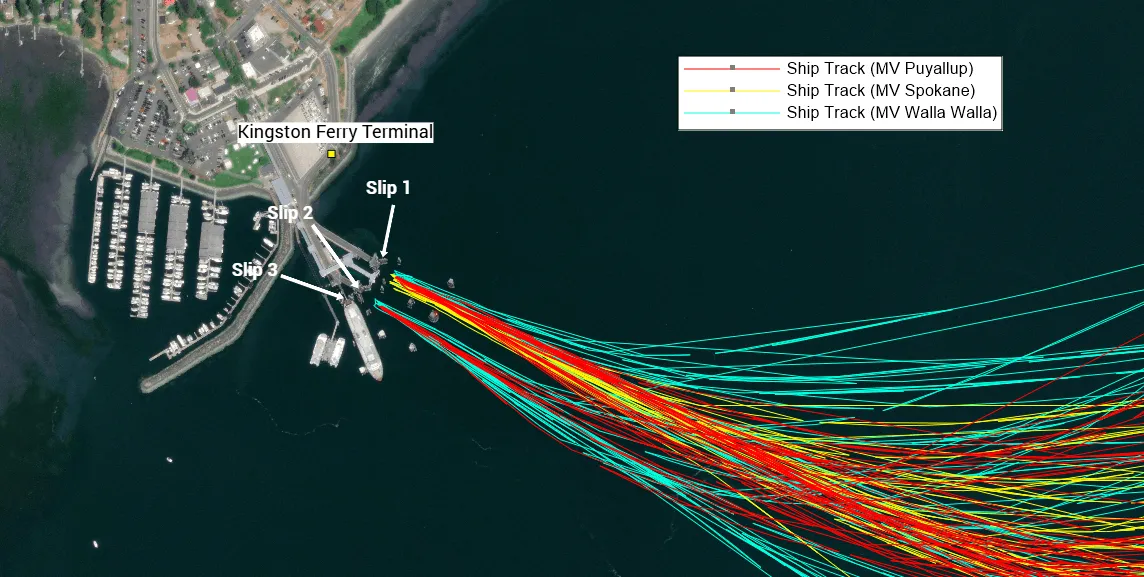
Propeller wash velocity simulation – Edmonds–Kingston Ferry Terminal, Puget Sound
DSI is conducting several studies of propwash impacts for commercial clients on sensitive Superfund projects. In addition, we have performed a modeling study for the Kingston Ferry Terminal. The Edmonds – Kingston ferry route across Puget Sound has 46 ferry trips every day and 322 trips every week. DSI engineers modeled the impacts of propeller wash on the Ferry Terminal. The model reasonably reproduced the ADV-observed velocity spikes due to the ferry departure in Kingston. The model predicted bed stress in exceedance of 6 Pa at the south piling, which can cause severe scour in a gravel bed. This shows the EEMS propeller wash modeling can be an effective tool for managing and mitigating ship scour issues.
This tool is commercially available as part of EEMS11 and continues to be developed by DSI for ongoing project needs.