

Confidential
Final report submitted to the U.S. Environmental Protection Agency (EPA) for review and approval.
Portland Harbor, located along the lower Willamette River in Oregon, is an EPA-designated Superfund site. Numerous studies have been conducted in this area, particularly within the river mile (RM) 4 to 7 reach, to assess contaminant transport and hydrodynamic processes. DSI has previously developed several numerical models of this region to support evaluations of toxic transport and sediment dynamics. In this project, DSI revisited an existing calibrated model and compared its results with newly collected Acoustic Doppler Current Profiler (ADCP) measurements. The ADCP dataset included both horizontal transect surveys and bottom-mounted velocity profiles. Using this data, DSI performed model calibration and validation to confirm that the model continues to accurately represent site hydrodynamics and remains a reliable tool for guiding future remediation design.
The purpose of this project was to validate DSI’s previously developed hydrodynamic model using the most recent ADCP data collected from Portland Harbor. This effort involved detailed processing of the ADCP measurements and refinement of the model calibration to align with observed flow conditions. All calibration adjustments, validation results, and model updates were thoroughly documented in a final report submitted to the U.S. Environmental Protection Agency (EPA) for review and approval.
EFDC+ and EFDC Explorer (EE) were utilized throughout the model recalibration and validation process. DSI conducted simulations over multiple time periods to ensure that the recalibration captured a range of flow conditions. Using EE, the number of vertical layers within the model domain was increased to achieve an optimal balance between vertical resolution and computational efficiency. Spatially varying bottom roughness values were applied, with higher roughness assigned to shallower areas to reflect site-specific hydraulic characteristics.
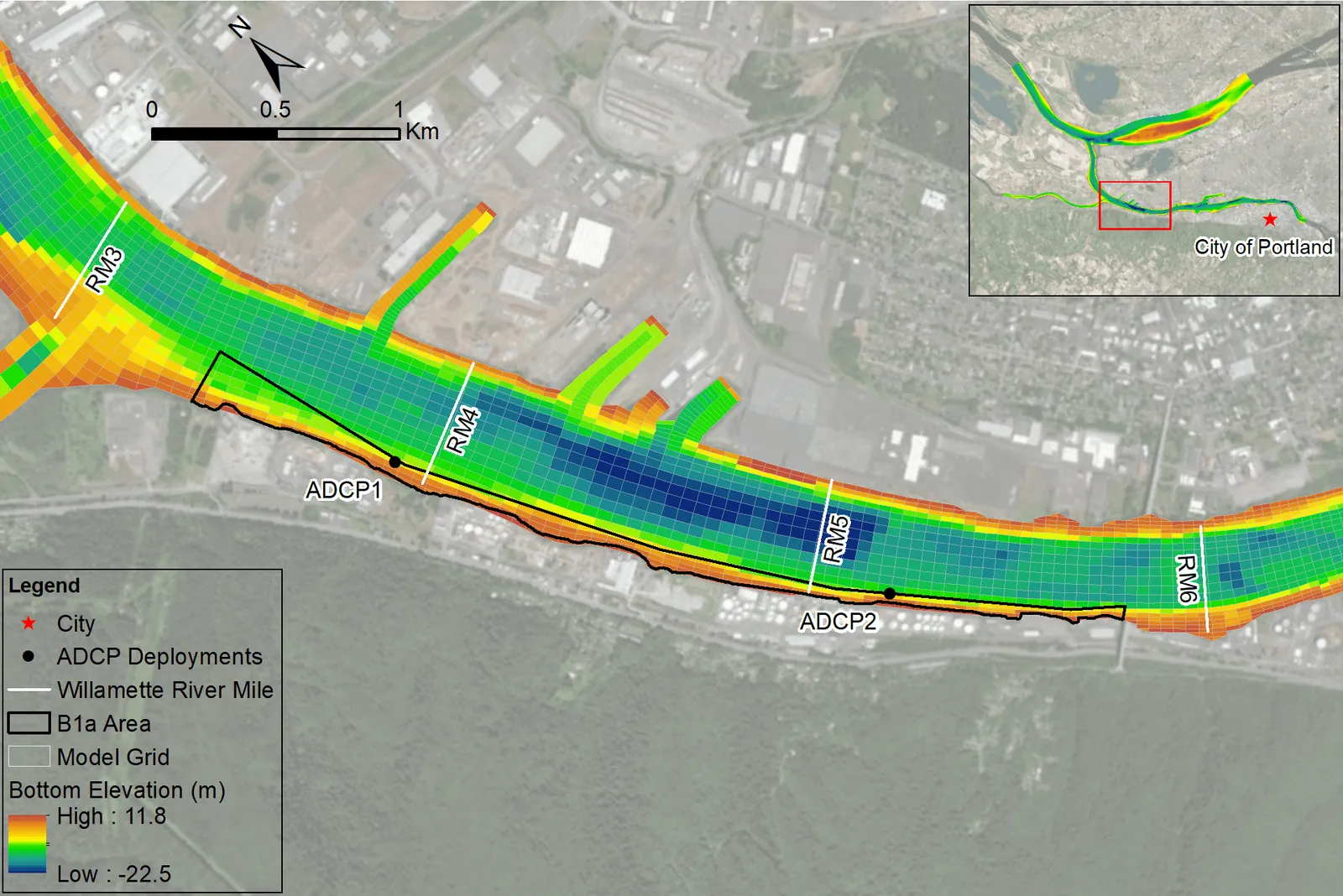 Portland Harbor hydrodynamic model – ADCP validation results, lower Willamette River
Horizontal transect ADCP data were processed into depth-averaged velocities and imported into EE for model-to-measurement comparisons. The vertical ADCP datasets were post-processed at discrete depths to facilitate direct comparisons with simulated velocity profiles.
The updated model provides the remediation design team with the most current hydrodynamic representation of Portland Harbor and has been approved by the U.S. Environmental Protection Agency (EPA) for continued use in support of remediation planning.