

Dema Law Group, LLP / NJDEP
DSI provided expert testimony about the extent of PFOA transport in the Delaware River Estuary.
Chambers Works site is situated along approximately 2.7 miles of the Delaware River Estuary shoreline, near Deepwater, New Jersey. Adjacent to the site, the Delaware River forms an oligohaline environment—a transitional zone between tidal freshwater and estuarine areas. Freshwater inputs from the upper watershed influence salinity levels here that vary tidally, seasonally, and annually.
Chambers Works utilized a permitted outfall, DSN002, for treated wastewater discharge, which contained perfluoroalkyl substances (PFAS). Both historical and current stormwater and wastewater outfalls have been serving as potential migration pathways to the Delaware River. These discharges act as a contaminant source for the surface to groundwater pathway along the Delaware River and in the tidally influenced regions of the Delaware’s tributaries.
This study developed a calibrated 3D hydrodynamic salinity model of the Delaware Estuary. The calibrated model was utilized to develop a tracer study of the discharge of PFOA (Perfluorooctanoic acid). The diffuser outfall was configured to account for near field mixing with dynamic coupling to the full Delaware Estuary model to enable evaluating the spatial and temporal distribution of PFOA from the outfall. DSI used a conservative tracer as a surrogate for transport from the outfall, which is located between River Miles 68.6 and 71.1 near Deepwater, New Jersey. Using model results for high and low flow conditions on the Delaware River, the extents and relative concentrations of the PFOA migration were determined.
During flood tide conditions, when upstream flow dominates, tracer concentrations exhibited pronounced shoreline accumulation with diffuse cross-channel dispersion. The extent of upstream migration varied dramatically with seasonal flow conditions:
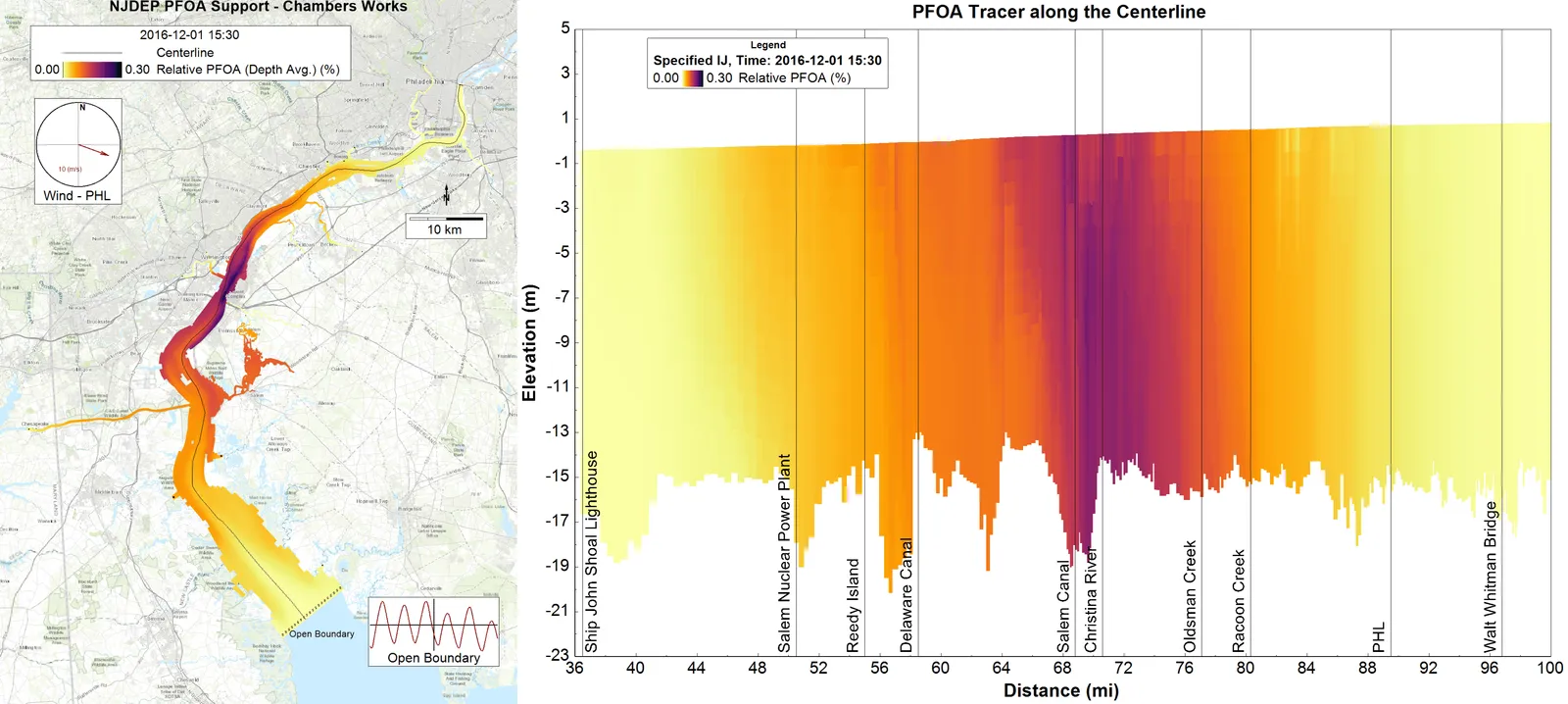 PFOA tracer concentration distribution in the Delaware River Estuary under high and low flow conditions
The modeling study supported the State of New Jersey’s enforcement action for PFAS management in and around the Chambers Works facility. The results of the study were used in testimony in Federal court.